
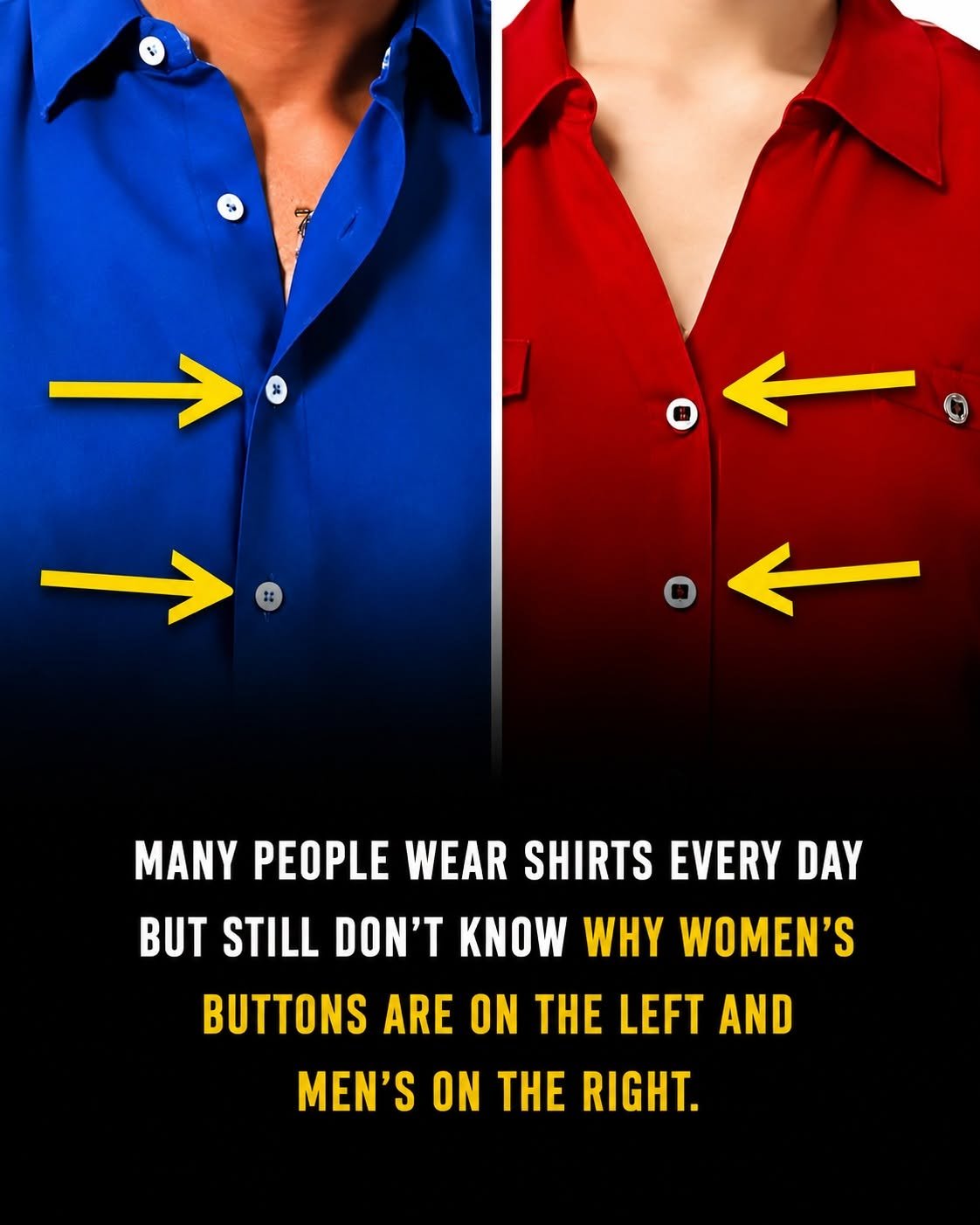
Why Are Women’s Shirt Buttons on the Left and Men’s on the Right?
Have you ever looked closely at a shirt and wondered why the buttons seem to be on different sides depending on whether the garment is made for a man or a woman?
It is one of those tiny details that most people never question.
On traditional men’s shirts, the buttons are generally placed on the right side, while women’s shirts typically have the buttons on the left.
But why?
The answer isn’t as simple as one official rule. Instead, the tradition appears to have developed from a mixture of clothing history, practicality, and changing fashion.
A Tradition That Goes Back Centuries
The left-right button difference became established long before modern mass-produced clothing.
Historically, clothing was often designed according to a person’s social position, occupation, and lifestyle. Wealthier women, in particular, frequently wore elaborate garments that were difficult to put on without assistance.
That may have influenced the placement of buttons.
One widely repeated theory is that women’s clothing was traditionally fastened by servants. Since most people are right-handed, placing the buttons on the wearer’s left side could have made them easier for someone standing opposite the wearer to fasten.
It is an interesting explanation—but historians don’t consider it a proven single origin for the tradition.
Why Men’s Buttons Are on the Right
There are also several theories about men’s clothing.
One explanation connects right-side buttons with the way men historically carried weapons.
For centuries, many men carried swords, knives, or other equipment on their bodies. Having clothing fasten on the right side may have made certain garments easier to open with the dominant hand.
Another theory suggests that men’s clothing was designed with practical activities in mind, including riding and military use.
However, just like the explanation for women’s clothing, there isn’t one universally accepted historical reason that definitively explains why men’s buttons ended up on the right.
Fashion Has a Long Memory
Once a convention becomes established, it can be surprisingly difficult to change.
Tailors, clothing manufacturers, and consumers become accustomed to a particular arrangement. Eventually, the difference becomes part of the visual language of men’s and women’s clothing.
Modern clothing doesn’t necessarily require buttons to be placed on opposite sides.
Yet manufacturers continue to follow the tradition because customers expect it.
In other words, the button placement has survived partly because fashion traditions tend to reproduce themselves.
Il resto è nella pagina successiva
